It is oppressively hot, nearly completely dark, the air thick, smelling of earth and fire entwined. Sudden, fierce movement, and a sea of tiny orange stars bursts forth, scattered in brief life as a high, resonant note sings out into the shadows, echoing, born of metal on metal. Again, that note rings, and again, each time accompanied by the momentarily blazing shower of diminutive stars, and again–a symphony of light and a single sound.
The smith is at his forge.
With fierce eyes and uncompromising focus he swings his hammer, shaping the shapeless, imbuing it with purpose, with utility, resurrecting that which was cast aside as useless detritus.
From slag and scrap he draws forth purer metal, working it anew and giving life to blades that cut crops or foes, plows that till the soil, nails that hold together houses, shoes that protect hooves, spikes that hold down the iron roads over which trains move, railings and fencing, pans in which food is cooked over fires like that of his forge, anchors that still ships, and uncounted other items. His eyes see potential in the scrap abandoned or overlooked by others and nothing upon which his vision falls is judged useless.
This is no ordinary man. This is Ogou Feray, blacksmith, warrior, lover, and he is one of the most popular and beloved lwa of Haitian Vodou. So today let’s dive into the layer-peeling that I so enjoy and explore the mystery that is Feray.
On the Surface
Feray’s origins stretch back to West Africa, and the Ìṣẹ̀ṣe religion. While his surname ‘Ogou’ is derived from Ogun, one of the spirits of this religion, his own name comes from a French word, feraille, which means ‘scrap’ or ‘junk’, yet this name does not describe him, referring instead to the abandoned and ignored metallic debris in which he sees the potential his vision allows him to foster.

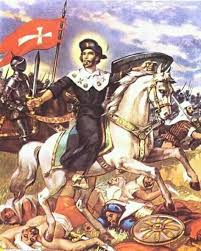
Feray is, of course, a blacksmith, drawing upon the magnificent, cross-cultural association of magic and power associated with that trade, but he is equally a powerful and indomitable warrior–for he both fashions the sword and wields it. He is boisterous, strong, willful, and hyper-masculine, but also protective, insightful, paternal, and just. He protects and defends the innocent, and brings justice where there is none. He was a driving power behind the Haitian Revolution, and fittingly is frequently served with the blue and red of the Haitian flag, just like Dantor (and indeed, these two are spouses in many, but not all houses; in some he is Freda‘s man). Different saint images are given to him in different houses, including St George and Santiago Matamoros (either as the saint himself or as the armored fella seen over his shoulder), although each image is also associated with other Ogou, depending on the house.
When he comes in possession he is given his favorite offerings, ones that are emblematic of Caribbean masculinity–rum, cigars, a sword or machete, even, by some, military uniforms such as colonial era soldier’s coats. And he will use these tools to reprove those who have erred, or to bless them, or impart spiritual strength. He will greet the women–and oh, is Feray ever fond of them, for in his eyes every woman is Woman!–and presents a swaggering, flirtatious, even dashing figure, yet can also be very attentive and observant. He is a lwa frequently married by women in Vodou, and fiercely protects his wives and devotees.
One will often see a burning fire built around a thin pillar or pole of iron at ceremonies; through this flame the Ogou, including Feray, will manifest. The heat and iron conjoined, of course, recall immediately his work as a smith. Feray shows the depth and complexity of the lwa, who are not as easily pigeon-holed as, say, the classical Greek gods, where it would require both Ares and Hephaestus and a dash of Zeus, at the least to capture his nature.
Naturally he is a hot lwa–the fire with which he is associated being not only that of the forge, but also that of the warrior’s blood that runs through his veins–I have watched him at fets, pouring rum and florida water into his horse’s hands, igniting it, and carrying on casual yet serious conversations with a fistful of fire. Fire is of his nature, and he doesn’t fear it, or, indeed, anything at all.
Under the Surface

Each of the lwa of the Nago nachon, the Ogou, is a vessel and representative of power and its expression in different ways. Military power (naval, aerial, etc), the power to heal, that of politics and diplomacy, and so on are each represented in this powerful and fierce nation. We might well then place Feray here where he seems to fit so easily–as the solider, the front line warrior leaping into the fray of revolution and war, flashing machete cutting down foes as he brings bloody justice to the oppressors of the world; a Haitian champion against whom none may long stand. Or we may look to the magnificent power of iron, which has changed the world and, when mixed with a little carbon (itself produced from fire in the ancient world) gives us steel. In this case we can see Feray as the blacksmith–the shaper of metal that gives us so much. We may remember his love and enforcement of justice–in West Africa there are those people who, to this day, swear oaths in court over a piece of iron in the name of Ogou. These oaths are not to be taken lightly, nor cast aside unfulfilled, and if taken in Feray’s name by those of us on this side of the Atlantic, must be kept or punishment will surely follow.
Yet these roles are just expressions of the true essence of who and what Feray is–transformation. He is the power to change, that is, the ability to manifest will and volition. The scrap or slag he finds and forges into useful items demonstrates that change in action, no less than his battlefield prowess, which is not mindless violence but the will and might to change societies, to cast off oppression, to strike down evil and create a better world. Even the taking of oaths in his name is transformation, for what is an oath but a pledge to modify what one does?
In this sense we see in Feray the principles at the heart of alchemy, seeking to change base lead into gold, and in a metaphorical sense, this is exactly what he does. The advance of technology is part of this change, this transformation he brings, and for this reason more than one person has linked him directly to technological innovation. This ability to transform what is into something new is fundamental to how the world works–what but Feray’s nature could take a poison like chlorine and a soft metal like sodium (which explodes in water) and combine them to make salt, which we need to live? That same process of renewal through transformation also takes two gasses, hydrogen and oxygen, and makes of them the water that is the major ingredient of the bodies of all living things.
It is Feray who spurs on social transformation as well–not just through the justified violence of the Haitian revolution, but also through the battle of ideological principles and the deep-seated desire to raise a fist and scream out to the sky for justice, for equity, for equality, for a world that edges, perhaps incrementally, closer to perfection. Feray is the power that roars enough! and declares that the time for settling, for accepting the status quo as just the way it is is now over. The force that is Feray was there when women began their struggle for rights, when the enslaved stood up for their freedom, when Jim Crow followed segregation in the US, and is still there today as African descended people fight for their rights. Feray well knows the difference between law and justice, and the police forces which should be an expression of justice dishonor him when they enforce an order that murders and oppresses.
His is the power of fire that does not actually destroy what it burns, but changes it into heat and light–that makes of base matter the energy that cooks our food, moves our vehicles, pushes back the cold of the chilly night, and melts the ice that rimes both mountain top and the human heart.
Isn’t the love he gives to his spouses and his devotees, manifested as protection and encouragement, not also a vector of change , of transformation? It is–for he changes dangerous and treacherous circumstances into security, poverty into opportunity, hunger into satiation, desperation into hope fulfilled.
In the End
Just as with each lwa there are many lenses through which we can see Feray–on the surface (what I like to call a “ceremonial thumbnail”), or, by peeling back the layers, to find a deeper understanding of who and what he is. The power of transformation, which I have described here in brief, is integral to who and what this great spirit is. The ability to see this in him, or to share that insight with others, is itself a manifestation of the same force, and I do hope this article will transform the view people have of Papa Ogou Feray and bring a deeper understanding of his place in the world.
It’s easy to see him as the brash warrior, or the blacksmith, but these are simply roles he plays in service to his true essence–to take what was before and remake it. This is a power and ability that has served Haitian Vodou well over the centuries, allowing it to shift and adapt, retaining its relevance in a changing world, to absorb that which serves its growth and discard that which seeks to stifle it.
Haiti itself has been rocked again and again by change–the political, environmental, social, spiritual, and cultural fabric of the country have always rolled with it, but as the these transformations run through the country, Haiti remains Haiti. Feray is a spirit whose essence runs through Haiti in profound and continual ways, and her people have always had an incredible knack for transforming what seems to be debris into art–such as the metal images made from old oil drum lids and tin scraps–as well as remaking their country since the days of the Revolution. Feray is change, and he finds the value in objects that others miss; Haiti has embraced this power, and the strength to weather those changes, and find the value in all things. And in this I know Feray find delight and unending pride.
Awoche Nago, Papa Ogou Feray! As I once told you at Freda’s fet in 2022, in my terrible Kreyol, mwen ba ou lanmou, onè ak respè. May it always be so.


I am here
LikeLike